

Video for SEO: Google’s Hidden Metric
By Matthew Stanton | November 3, 2026
Video for SEO sounds like a technical project. Most of the time it’s a placement decision. When a website isn’t pulling its weight in search, the conversation usually goes straight to keywords and backlinks, and those do matter. But some of what matters most happens after someone clicks. Do they stay and look around, or are they gone five seconds later? The short video below covers the idea in about a minute. This post goes a little further.
What Happens After the Click
Every search ends the same way. Someone types a question, scans the results, and picks one. What they do next is the part most websites never plan for.
If they land, see a wall of text and hit the back button, that visit didn’t do much for anyone. If they settle in, scroll, press play and keep reading, that’s a very different visit. They found what they came for.
In marketing circles that stretch of time is usually called dwell time. It’s the gap between clicking a search result and coming back to the results page. You won’t find it in your own reports, but you will find its close cousin, time on page, or average engagement time in Google Analytics.
Dwell time is the stretch between the click and the back button. Most websites never plan for it.
Why Search Engines Notice
Search engines pay attention to what happens after the click.
When someone clicks through to your site and leaves five seconds later, that’s a weak signal. It suggests the page didn’t give them what they came for. When they stay for two minutes, that’s engagement, and it sends a positive signal back to search engines that your page delivered.
Google is open about what it wants a page to do for the person who lands on it. Its documentation on creating helpful content asks site owners whether a visitor will leave feeling they’ve learned enough to reach their goal. It also asks whether they’ll leave feeling like they’ve had a satisfying experience.
A visitor who bounces in five seconds didn’t have that experience. A visitor who stays for two minutes, watches a clear explanation, and then clicks through to your contact page almost certainly did. That’s the visit search engines are built to reward. It’s also the visit that turns into business, and that’s the case for video for SEO.

When people stay, it sends positive engagement signals back to search engines.
Why Video Keeps People on the Page
Reading a thousand words feels like work. Watching a 90 second video doesn’t. That’s not a knock on reading. It’s just how most people browse, especially on a phone.
Marketers who use video see the same thing. In Wyzowl’s State of Video Marketing 2026 report, based on a survey of 266 marketers and consumers in late 2025, 82% of video marketers said video has increased dwell time on their website. The same share said it has increased traffic to their site. And 93% said it has helped people understand their product or service.
That last number is the one we’d pay the most attention to. A video doesn’t hold attention just because it moves. It holds attention because it explains something faster than the page around it can. Once a visitor understands what you do, they have a reason to stay, and usually a reason to take the next step.
The Mistake Is Where the Video Lives
Here’s something we see on a lot of websites. A business invests in a strong brand video, and then it ends up on a page called Gallery, or Media, or Videos, a few clicks away from where anyone actually lands. Hardly anyone finds it.
That’s backwards. Your best video belongs where your most important visits happen. Here’s where it usually earns its keep:
- Your homepage, near the top, where a first time visitor decides whether to keep going
- Your core service pages, where someone is deciding whether you can solve their problem
- Campaign landing pages, where every visit is one you paid for
- Your about page, if your people are a big part of why clients choose you
Google is fine with this, by the way. Its own video guidance says it’s fine to include the same video on both a dedicated watch page and another page alongside other information. You don’t have to choose between keeping a video library and putting your best work where it counts.
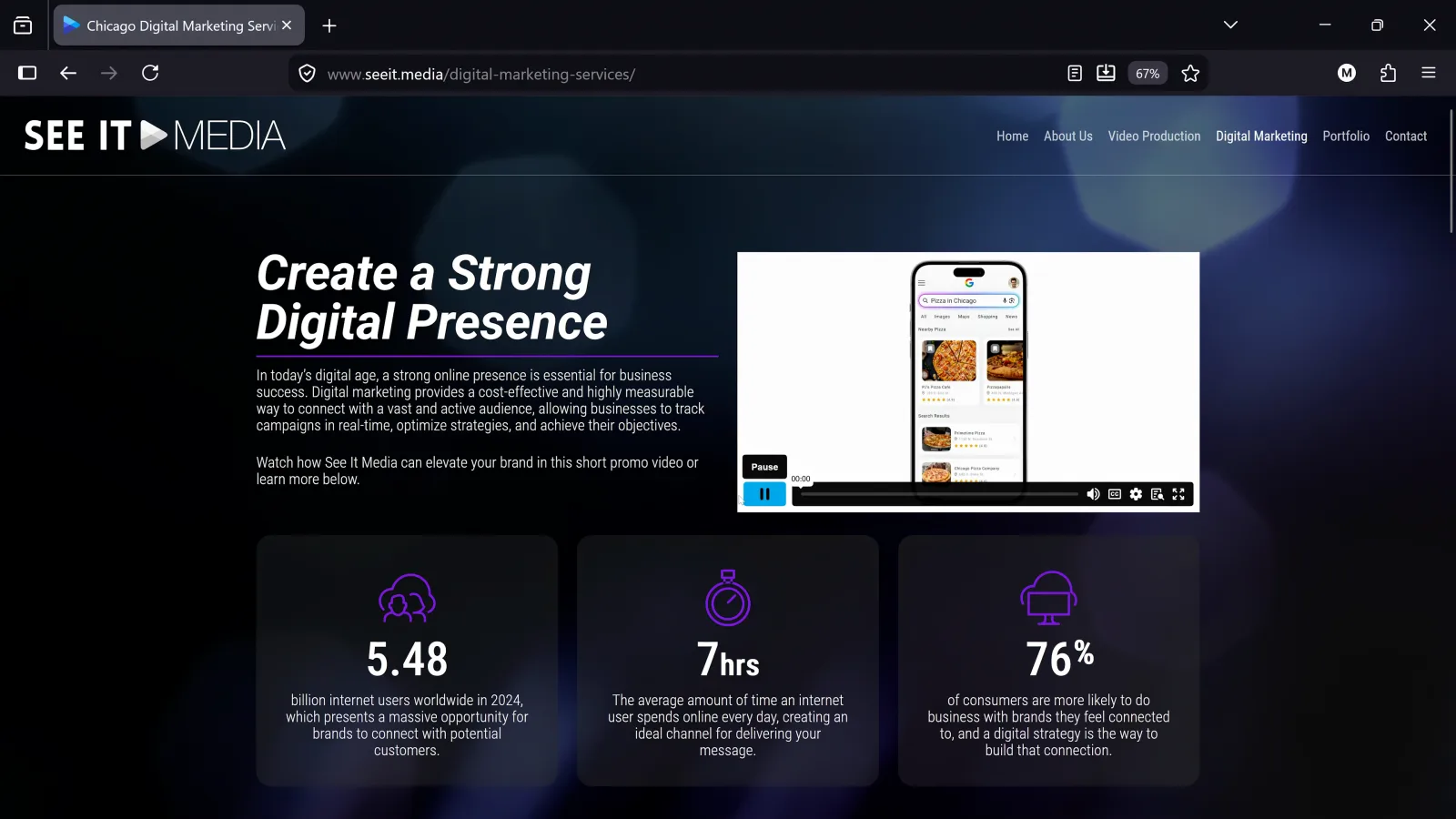
Our own digital marketing services page, with the video at the top where every visitor sees it first.
Placement Is Only Half of It
Dropping a video onto a page isn’t the whole job. Video for SEO only works if people actually watch, and a few practical details decide whether it holds anyone.
Put it where people can see it without hunting. A video at the bottom of a long page only gets watched by the few who made it that far.
Make the frame before the play button count. The thumbnail people see before they press play does the same job as a headline. If it’s a blurry frame of someone mid blink, it’s working against you.
Plan for the sound being off. Plenty of people browse muted, so captions or on screen text should carry the message on their own.
Keep the page fast. A huge video file that stalls the page on a phone undoes the whole point. Hosting the video on a proper video platform and loading the player only when it’s needed keeps the page light.
And keep it focused. A tight video that explains one service clearly will hold people longer than a long reel that tries to cover everything you’ve ever done.
Video for SEO Is Really Video for People
It’s easy to treat search as a game played against an algorithm. It isn’t, not really. Google’s stated aim is to send people to pages that satisfy them, so the work that helps your rankings tends to be the same work that helps your visitors.
Video is one of the most direct ways to do that work. It explains what you do and shows the people behind it, usually in less time than it takes to read a paragraph about it. The goal isn’t just a visit. It’s a meaningful stay.
At See It Media, we plan video around where it’s going to live, not just how it’s going to look. That means thinking about the homepage, the service pages and the first few seconds before a camera ever comes out. Take a look at our video production services and our digital marketing services, or browse the portfolio to see the work.
If you’re thinking about how video could strengthen your website, contact See It Media and let’s talk about putting your best video where it can actually work for you.


FAQs About Video for SEO
Q: Does video help SEO?
Yes. A well-placed video keeps visitors on your page longer, helps them understand what you offer, and gives them a reason to explore further. That engagement sends positive signals back to search engines. Those are also the outcomes Google’s own guidance says it wants pages to deliver, and the outcomes that bring in business.
Q: What is dwell time?
Dwell time is the time between someone clicking a search result and returning to the search results page. Google doesn’t report it to site owners. The closest numbers you can measure yourself are time on page and average engagement time, which you’ll find in Google Analytics.
Q: Where should I put video on my website?
Where your most important visits happen. Start with your homepage and your core service pages, and place the video near the top so visitors see it without hunting for it. A separate video gallery is fine to have, but it shouldn’t be the only place your best work lives.
Q: Will a video slow down my website?
It can if it’s added carelessly. Uploading a large video file straight to your site and loading it with the page can drag down load times, especially on phones. Hosting the video on a dedicated video platform and loading the player only when it’s needed keeps the page fast.
Q: How long should a website video be?
Long enough to explain one thing clearly, and no longer. For a homepage or service page that’s often between one and two minutes. A focused video that answers one question will usually hold attention better than a longer piece that tries to cover everything.
Recent Posts

Social Media Video: The False Reality of the Influencer Reel
Social Media Video: The False Reality of the Influencer Reel
Motion Graphics: Make the Complex Simple
Motion Graphics: Make the Complex Simple
Custom Website Design: Great Sites Are Never Accidents
Custom Website Design: Great Sites Are Never Accidents
