

Custom Website Design: Great Sites Are Never Accidents
By Thomas Schabow | August 4, 2026
Custom website design isn’t decoration. It’s a series of decisions that tell a visitor who you are before they read a single word. At the end of July we launched a new site for CM Event Design, a wedding and event planning company serving Chicago, South Florida, and Nashville. Here’s the thinking behind it, decision by decision, and why the same decisions matter for your brand.
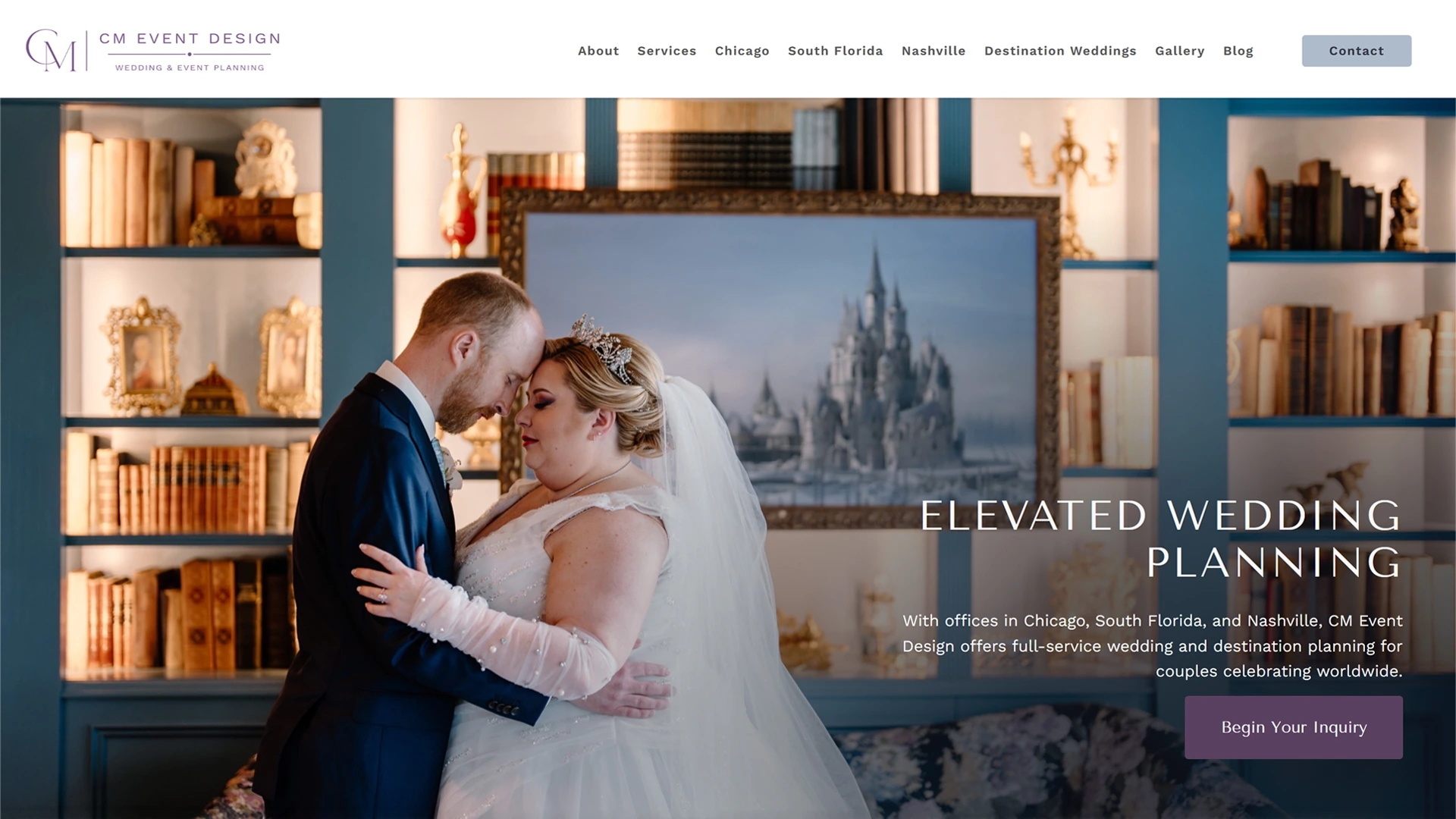
The CM Event Design homepage as it launched. Every decision described below is visible on it.
It Started With a Conversation, Not a Template
The first thing we did was get on a discovery call. Part of that call is practical. We need to know what the client wants, what she sells, and who she sells it to.
The more important part is less practical. We were also there to understand her as a person. A couple hiring a wedding planner isn’t really buying a service. They’re handing one of the biggest days of their life to a stranger and trusting her judgment. So the site had to carry her judgment, her calm, and her taste, not just her service list.
You can’t get that from a client in-take form. You get it from a conversation, and then you spend the rest of the project translating it into a layout.
We Studied the Competition and Found an Opening
Next we researched other planning companies across her markets. We expected polish. Instead, most of the sites we opened were chaotic. Clashing type, competing textures, and pages so busy it was hard to stay focused.
That’s a strange thing to find in the events industry. The entire promise of an event planner is that they bring order to something overwhelming. However, site after site was doing the opposite of that promise on first impression.
As a result, the opening was obvious. Calm was available, and nobody in her markets had taken it.
The Direction: Glossy Magazine Meets Stationery
Every custom website design needs a direction before it needs a layout. We set this one as clean, elegant, and elevated. The shorthand we used internally was glossy magazine meets stationery.
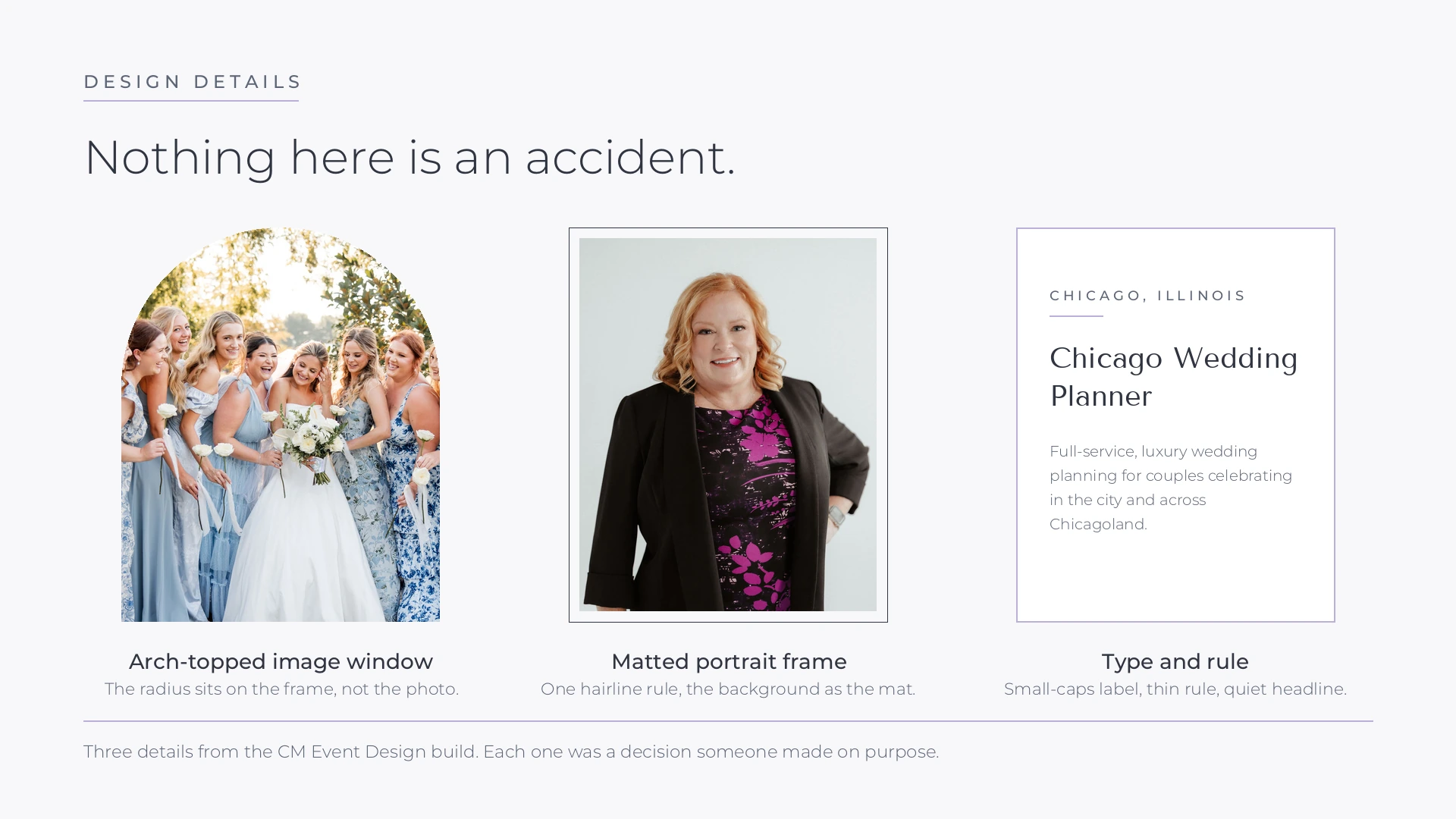
In practice that meant editorial white space, generous margins, and restraint. Photography gets room to breathe. Headlines are large and quiet rather than loud. Section labels are small and spaced out, the way a printed invitation handles them. The detailing stays deliberately understated: thin rules, narrow borders around the portraits, and softly arched tops on homepage feature images.
The goal was simple. A visitor should feel what they’d feel walking into one of her events. Considered and confident, without trying to prove anything.
Color and Type, Presented as Options
A custom website design should show its work. We didn’t hand over one look and ask for approval. We presented several color palettes and font pairings, because a client should see the range before committing to a direction.
What we landed on was a white base with a deep charcoal for text, a muted charcoal blue for the moody sections, soft lavender for accents, and a single deep purple reserved for buttons. Type is Tenor Sans for headlines and Work Sans for everything you actually read, with Cormorant Garamond italic held back for pull quotes.
Two rules governed all of it. First, the accent colors never carry text, because they aren’t readable at small sizes. Second, every text and background pairing had to pass WCAG AA contrast. That sounds like a technical footnote. In practice it’s the difference between a site that looks beautiful in a mockup and one that’s still legible on a phone, outdoors, or to someone with visual impairments.
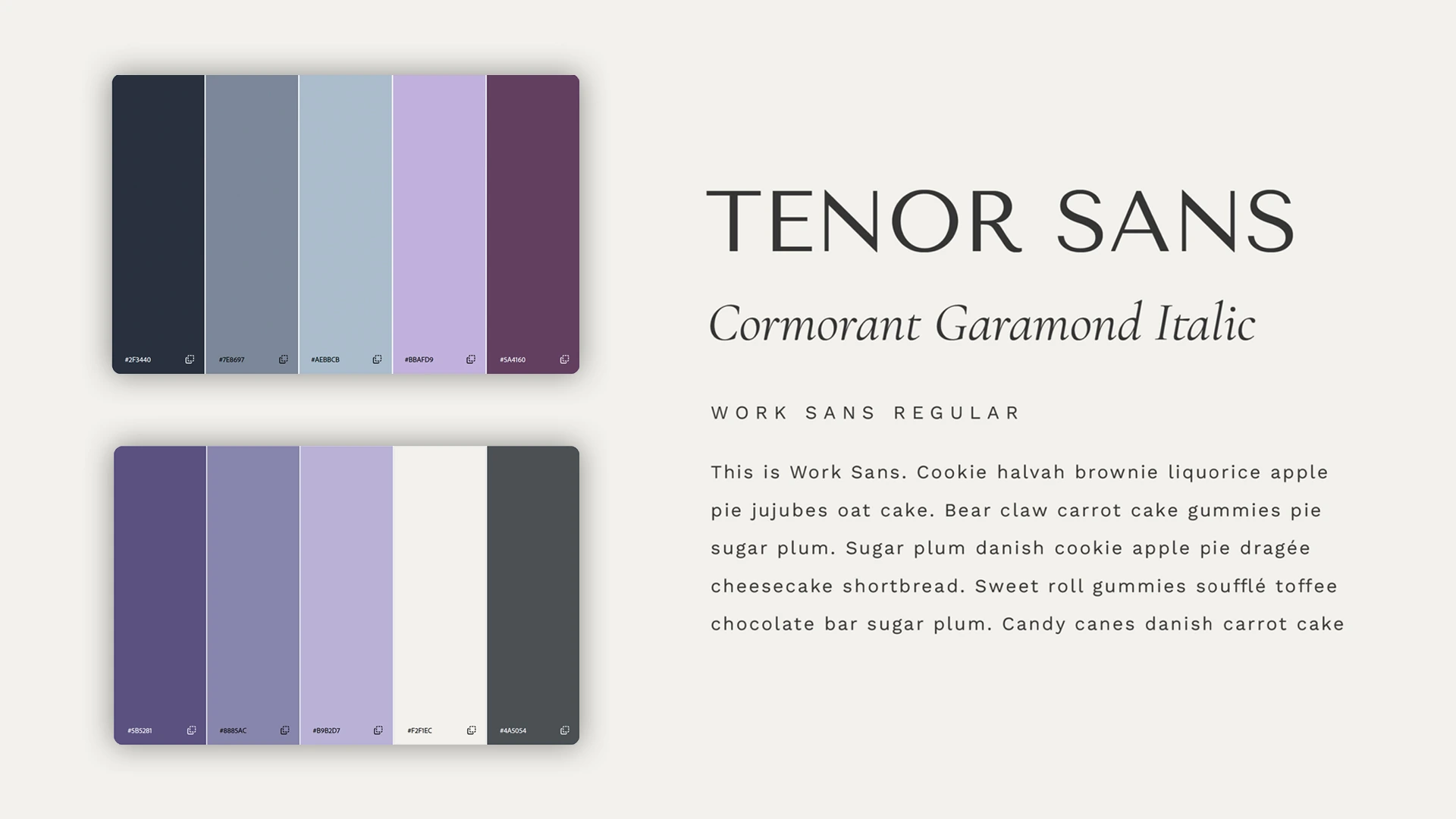
Several palette options and the type system the site was built on.
Motion, Used With Restraint
Modern sites move. Parallax backgrounds, fade-ins, hover lifts on cards, and section borders that draw themselves as you scroll are all on the site, and they all earn their place.
The discipline is knowing when to stop. Motion is easy to overdo, and the moment a site has too much of it, the effect flips from refined to garish. Every animation on this build is slow, small, and used sparingly. Meanwhile, the things a visitor is actually trying to do or read, are never interrupted by something sliding across the screen.
Structure Built for Search and for AI Answers
In custom website design, structure and search decisions are made at the same time, not in sequence.
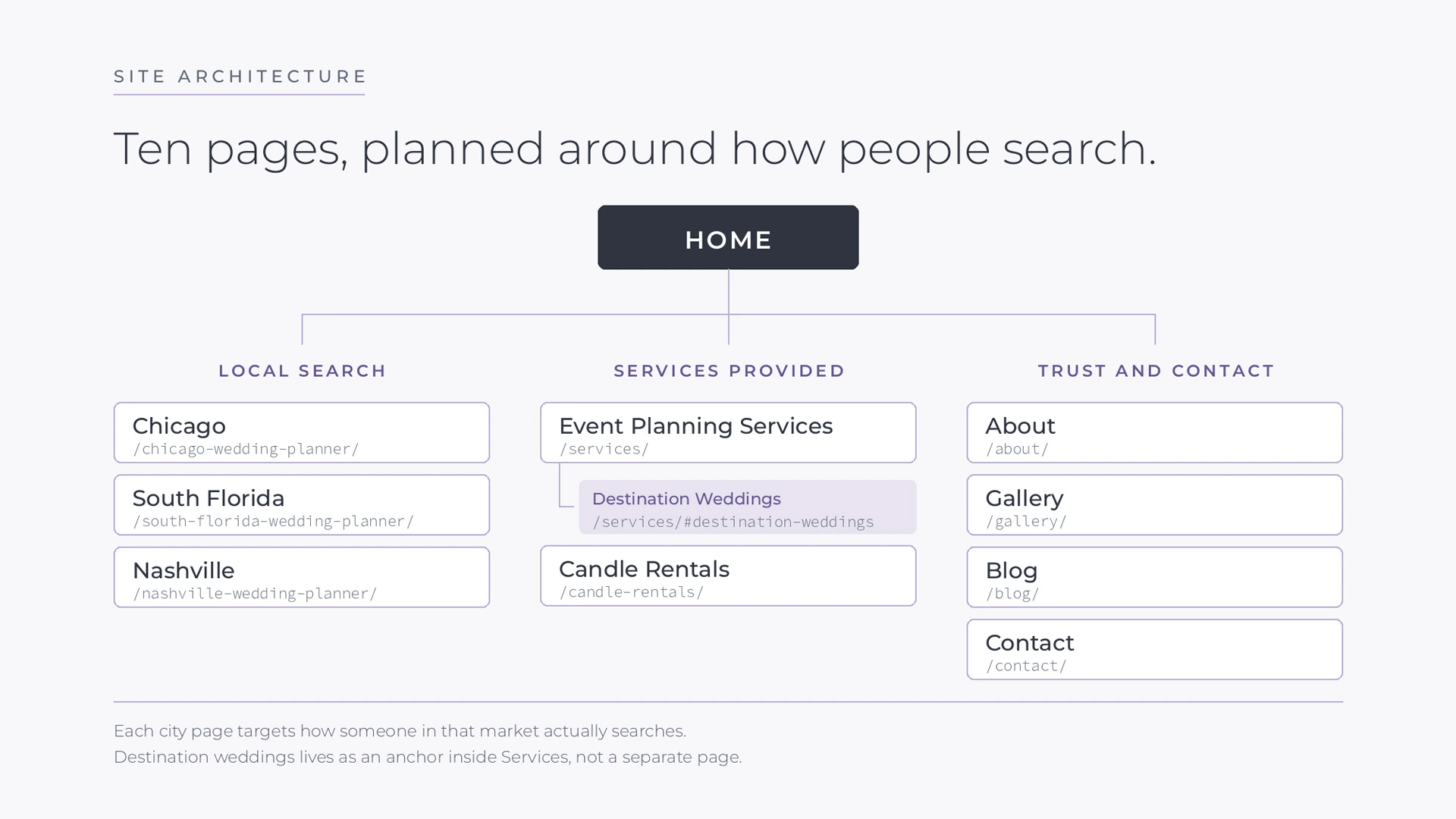
The page plan was built around how people actually search. Separate pages for Chicago, South Florida, and Nashville, each targeting how someone in that city looks for a planner. A services page that holds destination weddings as its own anchor. A dedicated page for candle rentals, which deserved its own address.
Underneath that, every page and every post carries a written title and meta description, the business details are marked up as structured data so search engines read the address and service area correctly, and the sitemap was submitted the day the site went live. We also published an llms.txt file, which is the emerging convention for telling AI systems what a site is and what it offers.
That last part is the shift worth paying attention to. People increasingly get answers from an AI summary instead of a list of blue links. Because of that, a site now has to be legible to software as well as to people. Clear structure is what makes both possible.
Why Custom Website Design Matters
It’s tempting to file design under taste. The research says otherwise.
Stanford’s Web Credibility Project put the question to more than 2,500 people. In that study, the visual design of a site was the single most commonly cited reason participants gave for finding it credible or not. Not the credentials. Not the copy. The look.
Speed is the other half of it. Visitors form an opinion about a page’s visual appeal in roughly 50 milliseconds, which is faster than reading a headline. We broke that down in The Trust Gap, so we won’t repeat it here. The short version is that the reaction lands before the reading starts, and it colors everything after.
For this client’s industry the stakes are concentrated online. The Knot’s 2024 Real Weddings Study found that 90% of wedding planning now happens online, that couples spend around six hours a week on it, and that 74% follow at least one of their vendors on social media. So her site isn’t a supporting document. It’s where most couples decide whether to reach out at all.
The psychology is the same in every industry. A cluttered site reads as a cluttered company. A calm one reads as competence.
Why a Human Designer Still Beats an AI Site Builder
Every hosting company now sells an AI website builder. Answer a few questions, and a site appears. It’s fast, it’s cheap, and for some situations it’s genuinely fine.
Here’s the limitation. An AI builder doesn’t know you. It has never spoken to your clients, never seen your work, and has no idea what makes you different from the four competitors down the street. So it does what these systems do by default, which is produce the average of everything it has already seen. That’s exactly how you end up with the chaotic sameness we found when we researched her market.
Search is the second problem. A generated site can produce pages, but it doesn’t choose which pages should exist, what each one should target, or how they should link to each other. Google’s own guidance is explicit that it rewards helpful, reliable, people-first content over content produced at scale to chase rankings. Strategy is the part being skipped, and strategy is the part that ranks.
None of this is an argument against AI. We use it, and we’ve written about training AI to actually sound like your brand. It’s an argument about how little a tool can decide on its own. Someone still has to know your business well enough to make those calls, and that starts with a conversation.
A Living Site, Not a Finished One
The site launched, and the client was thrilled. That’s the good part but it’s not the end of the project.
Custom website design doesn’t end at launch. Content gets added, sections get refined, and new work replaces old work as it comes in. Search engines reward that, because an active site signals an active business. In contrast, a site that hasn’t changed in three years tells both a visitor and an algorithm the same story.
So we treat launch as the starting line. The design holds, and the site keeps growing into it.
The Takeaway
Custom website design isn’t a look. It’s a stack of decisions about who you are, who you’re talking to, what they need to feel, and how software should read it. Every one of those decisions was made deliberately on this build, and the finished site is the sum of them.
If your website isn’t doing that work, we should talk. See It Media builds websites designed around your brand, not around a template. Contact us and let’s design something worth landing on.


FAQs About Custom Website Design
Q: How long does a custom website design take?
It depends on the number of pages and how ready the content is, but a small business site typically runs several weeks from discovery to launch. The design itself is rarely the slow part. Gathering photography, writing real copy, and getting decisions made are what set the pace, which is why we front-load those conversations.
Q: Is a custom website really better than an AI website builder?
For anything you expect to generate business, yes. An AI builder assembles a layout from patterns it has already seen, so it produces a competent average. It hasn’t spoken to your clients and can’t decide which pages should exist or what each one should target in search. That strategic work is what separates a site that looks fine from one that brings in inquiries.
Q: Does website design actually affect SEO?
Directly and indirectly. Structure, page planning, titles, descriptions, and structured data are design-phase decisions that determine how search engines and AI answer engines read your site. Indirectly, design affects how long people stay and whether they act, and those behaviors feed back into performance.
Q: What is AEO, and how is it different from SEO?
SEO is about ranking in a list of search results. AEO, or answer engine optimization, is about being the source an AI assistant uses when it answers a question directly. Both reward the same fundamentals, which are clear structure, honest information, and content that genuinely answers what someone asked.
Q: What happens to my website after it launches?
It should keep changing. Adding content, refining sections, and publishing new work all signal to search engines that the business is active, and they give returning visitors a reason to come back. A site that sits untouched for years slowly loses ground to competitors who are still publishing.
Recent Posts

Social Media Video: The False Reality of the Influencer Reel
Social Media Video: The False Reality of the Influencer Reel
Motion Graphics: Make the Complex Simple
Motion Graphics: Make the Complex Simple

AI for Your Brand: Make It Sound Like You, Not Everyone Else
AI for Your Brand: Make It Sound Like You, Not Everyone Else
