

Claims vs. Proof: Why Video Testimonials Win
By See It Media | June 16, 2026
A written testimonial is a claim. A real person on camera is proof.
We have all seen them: the classic five-star reviews plastered across website homepages. Short, sterile quotes attributed to “John D.” or “Sarah M.,” accompanied by a generic stock photo. Most prospects scroll right past them without a second thought.
It’s not necessarily because those reviews are fake. It’s because they feel like they could be fabricated. In digital marketing, modern buyers have developed a hyper-tuned radar for artificial praise. Skepticism is at an all-time high, and a simple text block on a website no longer carries the weight it used to.
When you rely solely on text-based reviews, you are forcing your prospects to take a leap of faith across a widening Trust Gap. To bridge that gap, you need to stop telling people how good you are and start letting your clients prove it for you.
The Psychology of “The Proof Problem”
Why are text reviews losing their bite? According to consumer research data, roughly 75% of consumers express explicit concern about encountering fake user-generated content and reviews online. Because anyone can type out a glowing paragraph and assign a five-star rating, text-only social proof has slowly devolved into commercial noise.
Video testimonials work on an entirely different psychological wavelength. When a prospect watches a video testimonial, they’re not reading a corporate claim; they’re witnessing objective proof.
-
Mirroring and Empathy: Viewers naturally see themselves in the speaker’s situation. They hear the exact frustrations, pain points, and hesitations the client experienced before hiring you – and they watch those hesitations physically disappear as the client explains your solution.
-
Undeniable Authenticity: Human beings are experts at reading micro-expressions, vocal inflections, and body language. You cannot easily fake the genuine relief or excitement in a client’s voice when they talk about a massive problem you solved for their business.
-
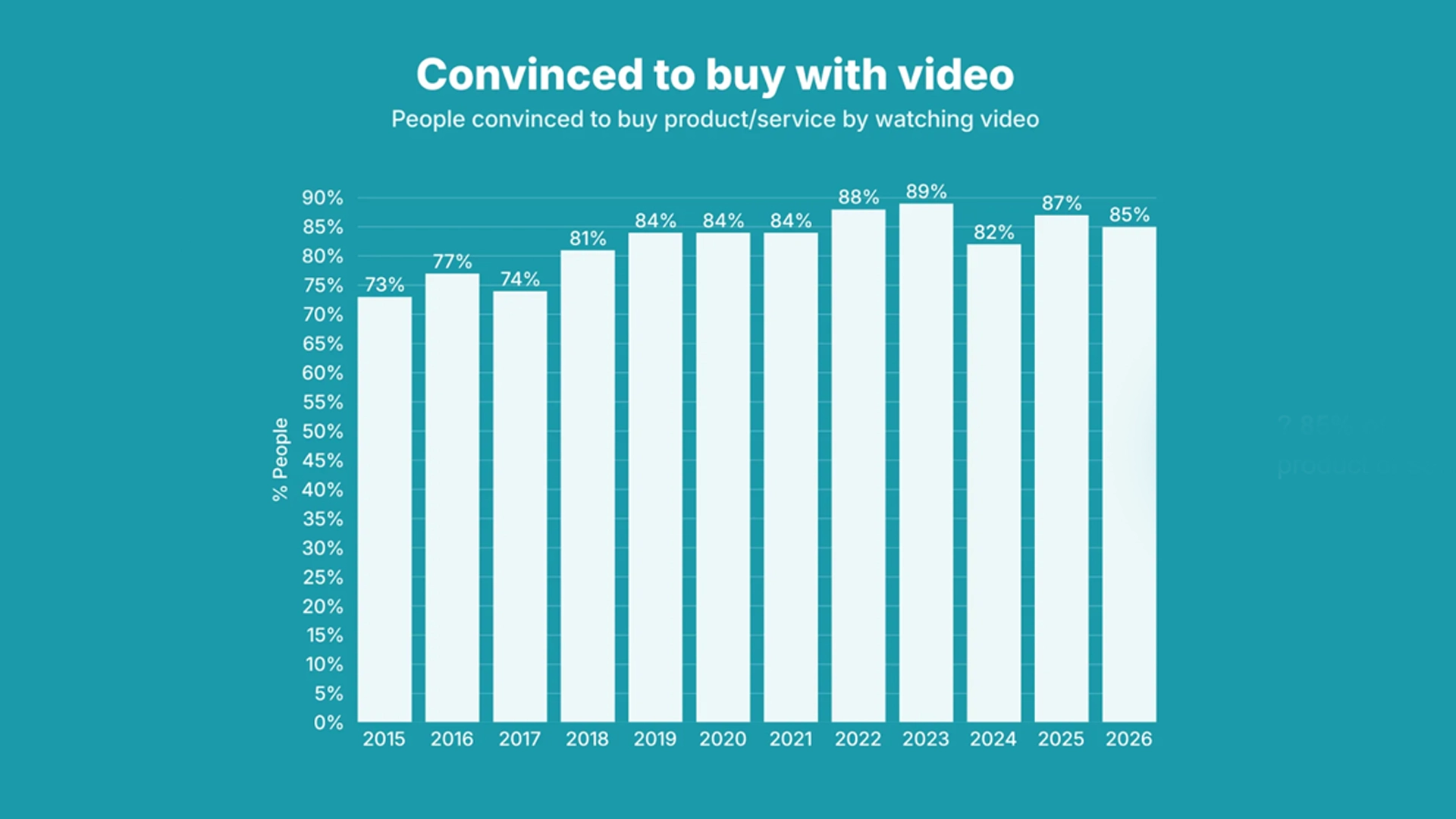
The Power of Third-Party Validation: Studies consistently show that 9 out of 10 people trust what a customer says about a business far more than what the business says about itself. In fact, an overwhelming 85% of consumers state that watching a video has directly convinced them to make a purchase.
By upgrading from text to video, you transform passive readers into highly engaged viewers, breaking down sales friction before your team ever jumps on an initial discovery call.
Case Study: Building Borderless Trust for Oglethorpe University
The challenge of bridging the trust gap is universal, but it is magnified when your audience is making a life-altering decision – like moving across the world for higher education.
When we partnered with Study Group to create a series of recruitment videos, the objective was clear: attract international students to attend the Oglethorpe University International Study Center.
Instead of deploying traditional marketing scripts or static website brochures filled with blocks of text, we produced a series of cinematic testimonial videos. We sat down and interviewed real international students, faculty members, and campus staff to let them speak directly to prospective families.
The impact of this approach relies entirely on first-hand emotional security:
-
Overcoming High-Stakes Hesitation: For an international student, choosing a university involves navigating immense anxiety about cultural integration, safety, and academic support.
-
Living Proof: Seeing a peer from their home country sitting on the Oglethorpe campus, smiling, and saying, “Hey, it’s great here, you’ll love it too,” provides a layer of comfort that text simply cannot replicate.
-
A Complete Trust Ecosystem: By capturing the perspectives of students (peer validation), faculty (academic security), and staff (operational support), the videos created a cohesive shield against skepticism, offering absolute proof of a welcoming campus environment.

Oglethorpe University in Atlanta, Georgia
Turning Content into Sales Leverage
A common mistake businesses make is treating a high-quality video testimonial like a one-time social media post. Once the video is produced, it shouldn’t just sit on a feed – it needs to be deployed strategically across your entire marketing and sales ecosystem to act as permanent leverage.
-
High-Value Website Real Estate: Integrate your video testimonials directly onto your primary landing pages, pricing pages, or case study sections. Replacing a static text review with a rich video asset dramatically increases on-page dwell time and directly boosts conversion rates.
-
The Mid-Funnel Sales Deck: Equip your sales team with targeted video testimonials. If a prospect expresses hesitation about a specific element of your on-boarding process or service delivery during a call, follow up by sending a video of a past client discussing exactly how you solved that precise problem for them.
-
Native LinkedIn Sequences: In B2B spaces, decision-makers are actively looking for peer recommendations. Sharing short, punchy case study clips natively on LinkedIn positions your brand as an industry authority and keeps your real-world results top-of-mind for prospective clients.
Stop Claiming. Start Proving.
If your marketing strategy relies on text quotes with first names only, you’re leaving your conversion rates at the mercy of consumer skepticism. It’s time to let your clients do the heavy lifting for you.
Ready to transform your best customer success stories into your most powerful sales assets? Contact See It Media today, and let’s discuss how we can build undeniable proof for your brand.
FAQs About Video Testimonials
Q: Why are video testimonials more effective than written reviews?
Written reviews are incredibly easy to manipulate or fake, leading to high consumer skepticism. Video testimonials introduce real faces, voices, body language, and emotions, providing undeniable visual proof that a client is genuine and that the results are real.
Q: How do video testimonials help shorten the B2B sales cycle?
Video testimonials address prospect objections, minimize hesitation, and answer common questions before a lead ever books a sales call. By showcasing real clients detailing how you solved their specific problems, you build pre-established trust and significantly reduce mid-funnel friction.
Q: What makes a client testimonial video feel authentic rather than staged?
Authenticity stems from open-ended, conversational interviewing rather than forced scripts. Allowing clients to candidly discuss their initial hesitations, the realities of the problem they faced, and the specific metrics of their success creates an organic narrative that viewers naturally trust.
Q: Where are the best places to display video testimonials to increase conversions?
To get the most leverage, place video testimonials on high-traffic landing pages, pricing sections, and directly next to contact forms to reassure users right before they reach out. They are also highly effective when embedded in active sales decks or shared natively on professional networks like LinkedIn.
Q: How long should a video testimonial ideally be?
For optimal engagement, a comprehensive video testimonial should be between 60 and 90 seconds. This provides enough time to establish the client’s initial problem, your solution, and the tangible results achieved without losing the viewer’s attention. Shorter 15-to-30-second clips can then be carved out for quick social media assets.
Recent Posts

Social Media Video: The False Reality of the Influencer Reel
Social Media Video: The False Reality of the Influencer Reel
Motion Graphics: Make the Complex Simple
Motion Graphics: Make the Complex Simple
Custom Website Design: Great Sites Are Never Accidents
Custom Website Design: Great Sites Are Never Accidents
