

AI Search Visibility: How to Get Your Business Cited
By Thomas Schabow | November 10, 2026
AI search visibility comes down to one question. When someone asks about the kind of work you do, does your business show up in the answer? More and more, that answer isn’t a list of ten blue links. It’s a few paragraphs written by AI at the top of Google, or a reply in ChatGPT, with a handful of sources cited along the way. If you’re one of those sources, you’re in the conversation. If you’re not, a lot of people will never scroll far enough to find you.
Search Results Now Come With an Answer on Top
Google’s AI Overviews and AI Mode write a summary before the regular results. ChatGPT, Perplexity and the other assistants do the same thing in a chat window. For a quick question, plenty of people read the summary and move on.
You can see it in the numbers. In February 2026, Ahrefs re-ran its click study using December 2025 data across 300,000 keywords. It found that when an AI Overview appears, the page ranked first gets an average click-through rate 58% lower. A year earlier the same study had found a drop of 34.5%.
That doesn’t mean search stopped mattering. It means ranking well is no longer the whole job. The new goal is to be one of the sources the answer is built from.
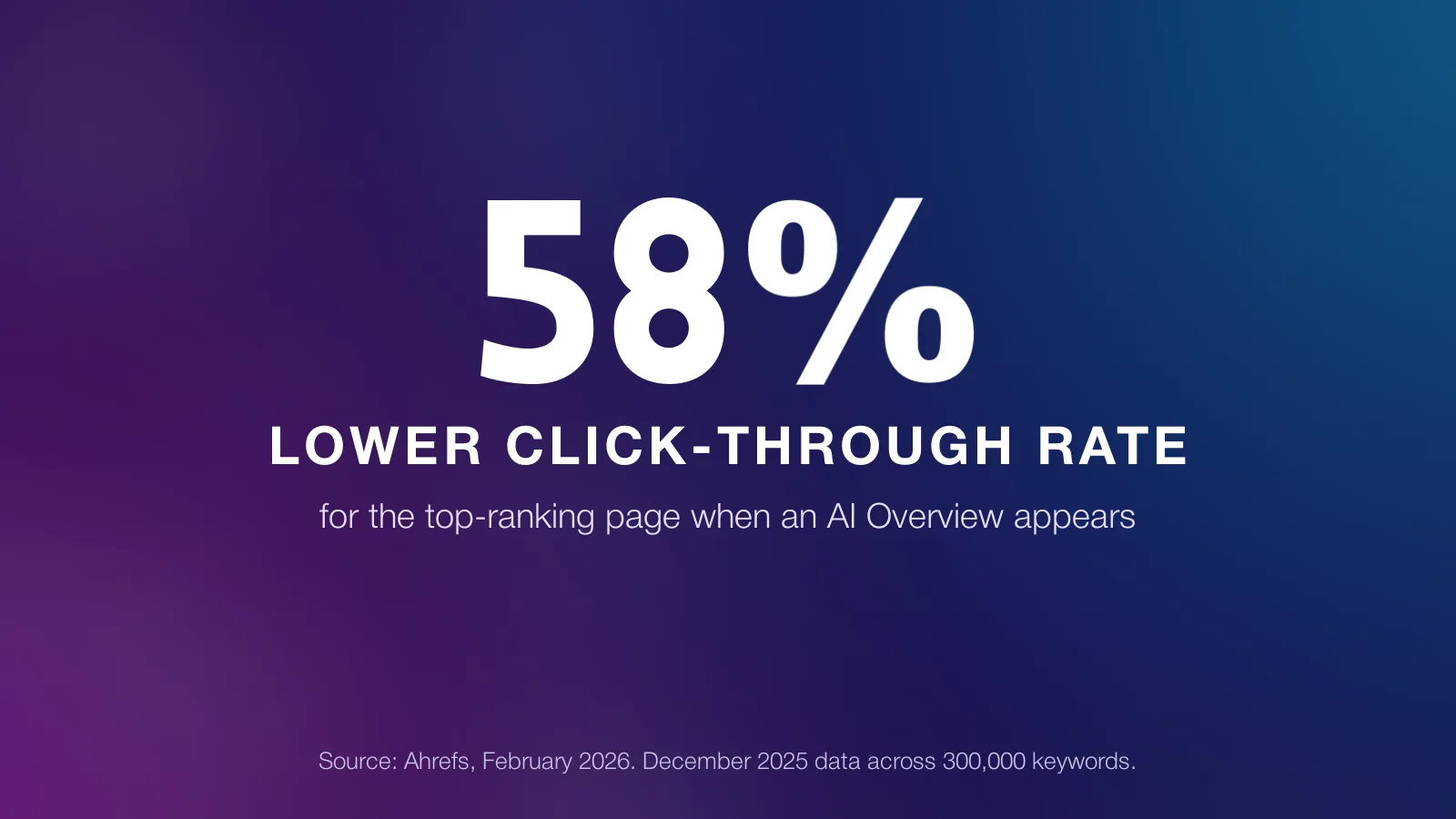
When an AI Overview appears, the top result gets far fewer clicks.
Being Cited Is the New Ranking
Here’s the encouraging part. In its April 2026 update, Seer Interactive tracked 53 brands across 5.47 million queries. On informational searches, brands cited inside an AI Overview earned about 120% more organic clicks per impression than when they weren’t cited.
Seer is careful to call that a correlation rather than proof, since stronger brands are also more likely to get cited. Still, the direction is clear. When an AI answer appears, the sites it names tend to get noticed. The ones it leaves out tend to get passed over.
So the question for any business becomes practical. What makes an AI system pick your page as a source?
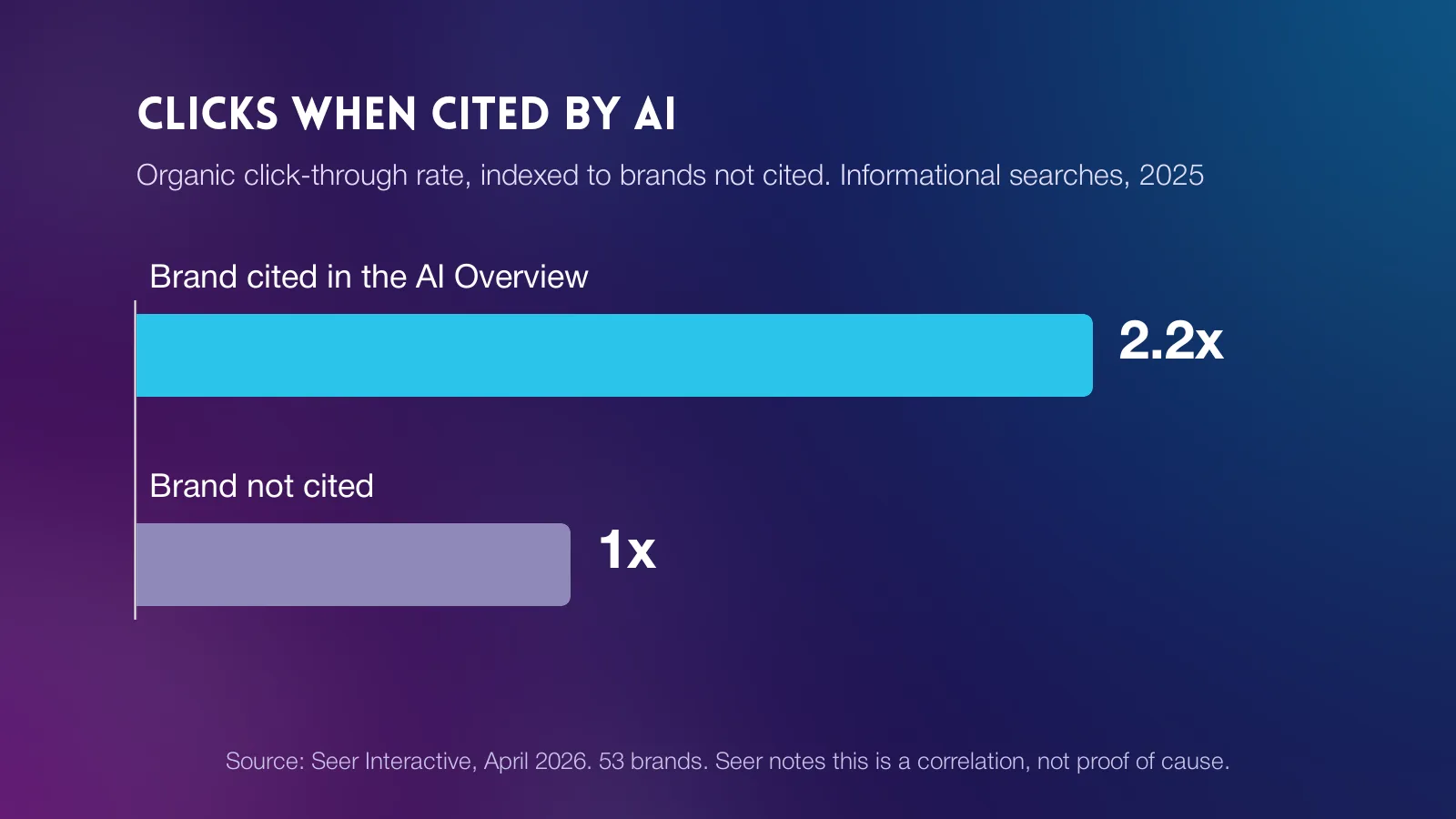
Brands cited inside an AI Overview earned more than twice the click-through rate of brands left out.
What Google Says It Takes
Google’s answer is refreshingly plain. Its guidance on AI features and your website says there are no additional requirements or special optimizations needed to appear in AI Overviews or AI Mode. A page simply has to be indexed and eligible to show in Google Search with a snippet. Google even says you don’t need new machine readable files or special AI text files to get in.
In other words, the fundamentals still decide it. Google’s own list of best practices reads like a good SEO checklist:
- Let search engines crawl your site, in robots.txt and in any hosting or security layer in front of it
- Link your pages to each other so important content is easy to find
- Put your key information in actual text, not only inside images or video
- Support that text with good images and video where they help
- Make sure any structured data matches what’s visible on the page
- Keep your Google Business Profile up to date
None of that is new. What’s new is how much it costs you when it’s missing.
Don’t Lock the Door on ChatGPT
ChatGPT search finds websites with its own crawler, called OAI-SearchBot. According to OpenAI’s crawler documentation, sites that opt out of OAI-SearchBot won’t be shown in ChatGPT search answers. OpenAI runs a separate crawler, GPTBot, for training its AI models, and each setting is independent of the other.
That distinction matters. A business can say no to its content being used for training and still say yes to being found in ChatGPT search. But the two get lumped together all the time, and some sites end up blocking every AI crawler without anyone deciding to.
It’s worth a five minute check. Look at your robots.txt file, and ask whoever manages your hosting or security settings whether anything is turning these crawlers away. If your site is invisible to the crawler, it’s invisible in the answer.
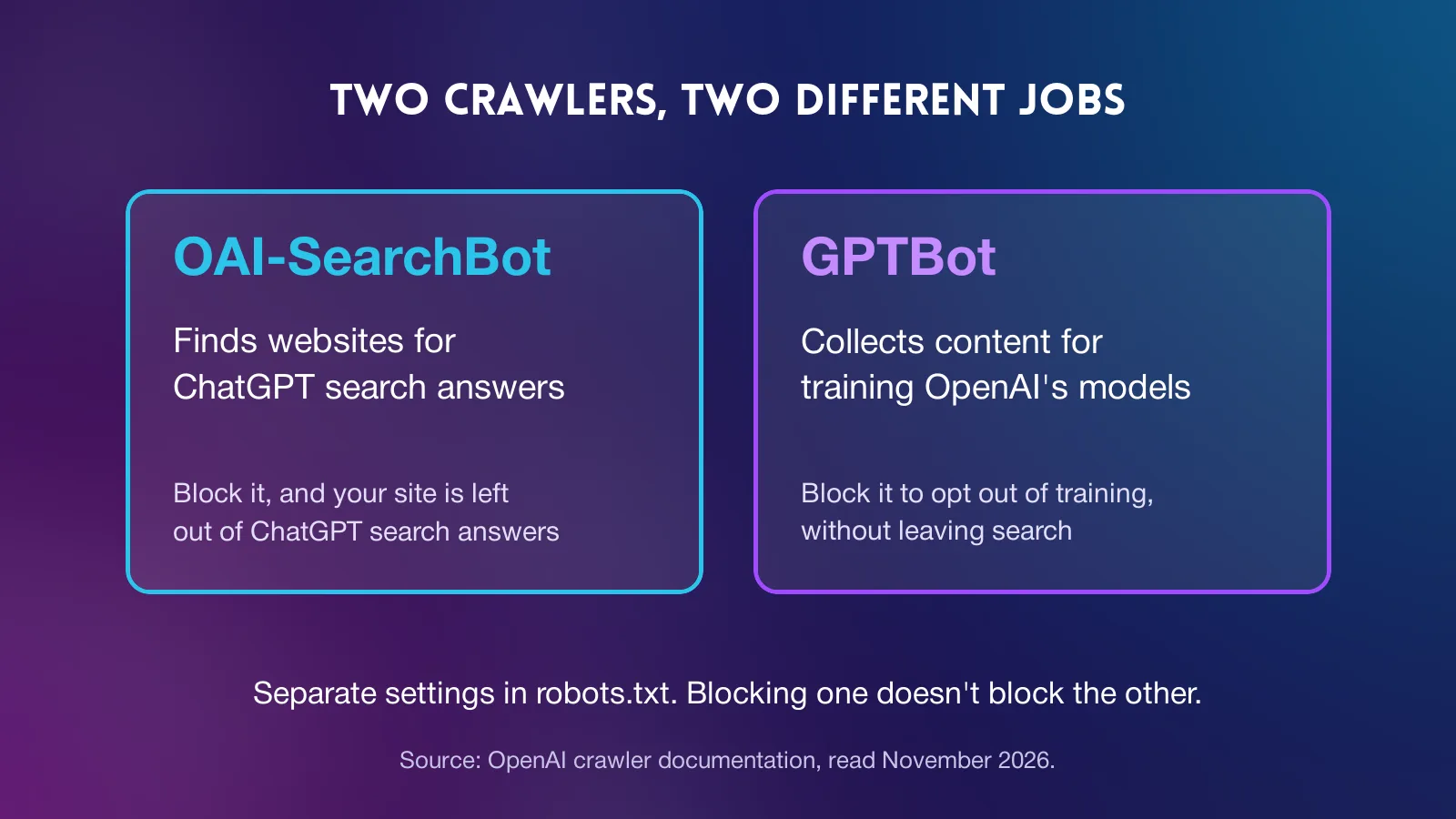
Blocking the training crawler doesn’t have to mean disappearing from ChatGPT search.
Write Pages That Answer Questions
AI systems are built to answer questions, so they lean on pages that answer them clearly. That’s a writing problem as much as a technical one.
Start with the questions your clients actually ask you. What does it cost? How long does it take? Do you work with businesses like mine? Then answer them directly, in plain language, on the pages where people are deciding. A vague paragraph that circles the point is hard for a person to use and just as hard for an AI to quote.
Structure helps too. Descriptive headings and short sections make it easy to see what each part of a page is about. An FAQ section at the end of a service page or a blog post is one of the simplest things you can add for AI search visibility, because it hands the AI a set of ready answers. That’s exactly why this post ends with one.
Structured data is the last piece. Schema markup for your business, your articles and your FAQs tells search engines what your content is. It only helps when it matches what’s actually on the page, which is the same point Google makes.
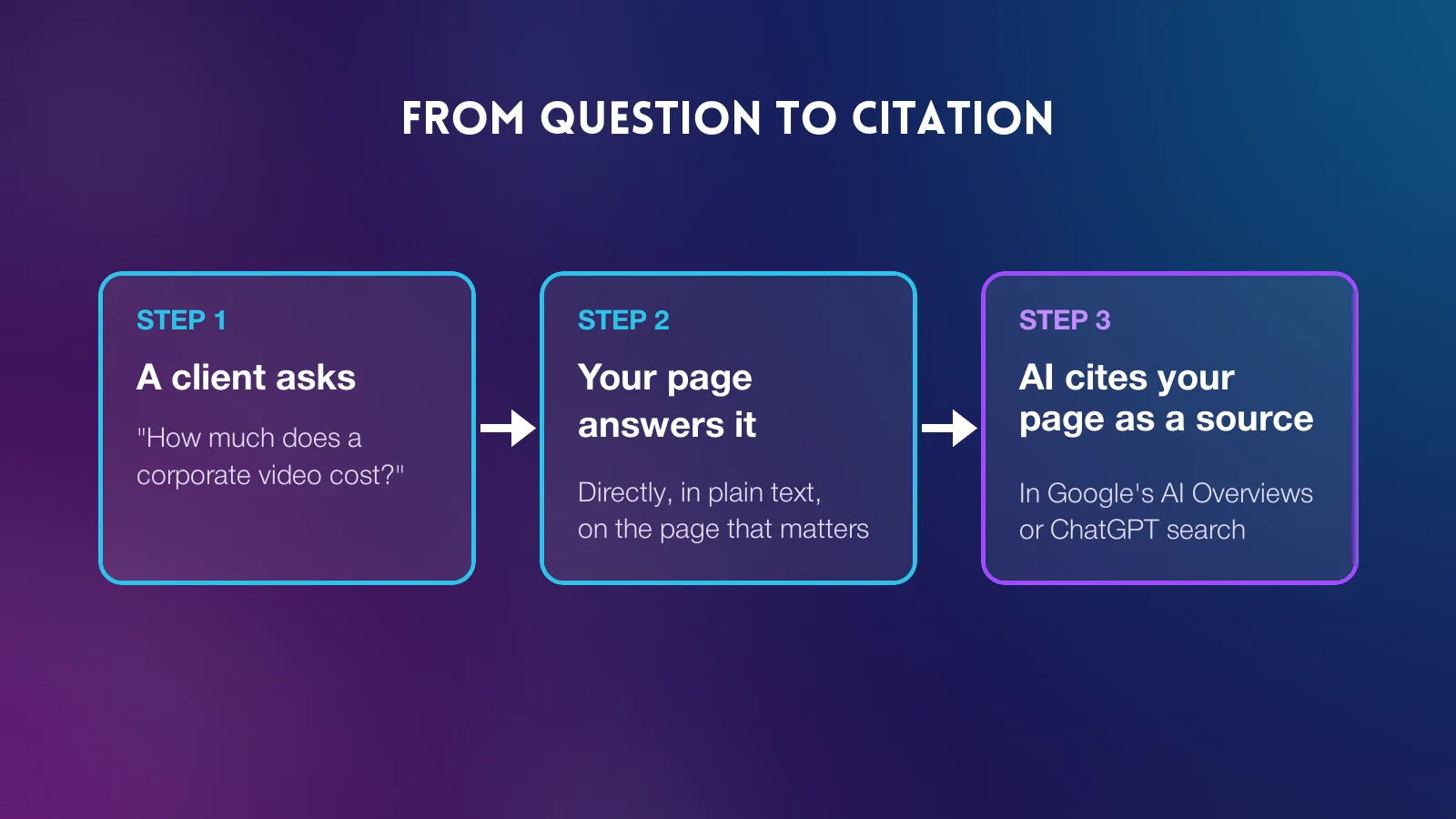
Answer the question clearly, and you give AI a reason to cite you.
Give AI Something Worth Citing
Clear writing gets you considered. Substance is what gets you chosen. A page that says the same thing as fifty other pages gives an AI no reason to pick it.
The pages that stand out tend to offer something specific, like a real number from your own work or a process explained step by step. Sometimes it’s simply the view of someone who’s done the job for years. Named authors with real experience help as well, because they show who’s behind the advice.
Video belongs here too. Google’s own checklist mentions supporting text with high quality images and video, and a good video keeps visitors on the page once they arrive. We covered that side of it in Video for SEO. And once AI search sends someone your way, your site still has to earn their trust in the first few seconds, which is the Trust Gap all over again.
AI Search Visibility Starts With the Basics
It’s tempting to treat AI search visibility as a new trick to learn. Mostly it isn’t. It rewards what good search always has, a site search engines can actually read and content that answers the questions people are asking.
One caution. Nobody can promise you a spot in an AI answer, and it’s worth being wary of anyone who does. What you can do is remove the reasons to leave you out.
At See It Media, AI search visibility is part of every SEO audit we run, alongside the technical and local work. We check what search engines and AI crawlers can see, then build content that answers the questions your clients are asking. Take a look at our digital marketing services to see how it fits together.
If you’d like to know how your business shows up when people ask AI about what you do, contact See It Media and let’s take a look together.


FAQs About AI Search Visibility
Q: What is AI search visibility?
AI search visibility is how often your business appears in answers written by AI, such as Google’s AI Overviews and AI Mode or ChatGPT search. It covers whether your site is mentioned or linked as a source when someone asks a question related to what you do.
Q: How do I get my business to show up in AI search results?
Start with the fundamentals. Make sure search engines and AI crawlers can reach your site, put your key information in plain text, and answer the questions your clients ask directly and clearly. Accurate structured data and an up-to-date Google Business Profile help search engines understand who you are. Google says no special optimization beyond that is required to appear in its AI features.
Q: Do I need an llms.txt file?
Not for Google. Its guidance says you don’t need new machine readable files or AI text files to appear in AI Overviews or AI Mode. Some SEO plugins create an llms.txt file automatically, and ours does, but it’s an optional extra. It won’t make up for a site that’s hard to crawl or content that doesn’t answer questions.
Q: Should I block AI crawlers from my website?
It depends on what you’re blocking. OpenAI uses one crawler, OAI-SearchBot, to find sites for ChatGPT search, and a separate one, GPTBot, for training its models. Blocking OAI-SearchBot keeps your site out of ChatGPT search answers. Blocking only GPTBot opts out of training without affecting search. Check what your robots.txt and security settings actually do before deciding.
Q: Is SEO still worth it if AI answers the question?
Yes. AI answers are built from pages that search engines have already indexed, so SEO is how you become eligible to be cited in the first place. Research from Seer Interactive in April 2026 also found that brands cited in Google’s AI Overviews earned more clicks than brands that weren’t, so being part of the answer still brings visitors.
Recent Posts
Video for SEO: Google’s Hidden Metric
Video for SEO: Google’s Hidden Metric

Social Media Video: The False Reality of the Influencer Reel
Social Media Video: The False Reality of the Influencer Reel
Motion Graphics: Make the Complex Simple
Motion Graphics: Make the Complex Simple
