


AI for Your Brand: Make It Sound Like You, Not Everyone Else
By Thomas Schabow | July 25, 2026
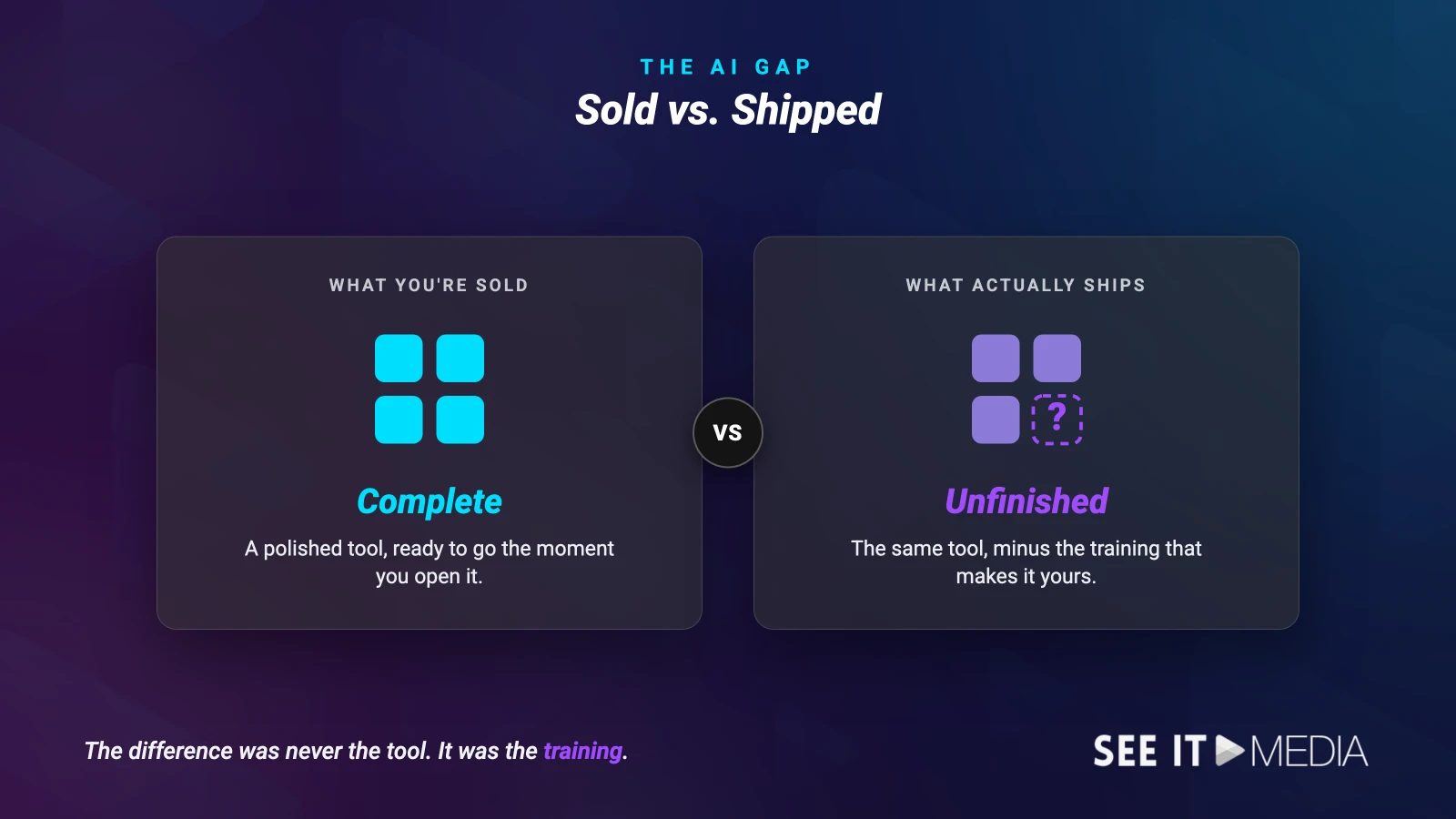
AI for your brand is trained, not just bought. If you’ve tried an AI tool and come away underwhelmed, you probably landed on one of two conclusions. The tool is overhyped, or you’re the problem. It’s almost always neither. What you were sold showed up unfinished, and the part that makes it actually work was never in the box.
That missing part is the whole game. It’s why the same tool can turn out generic filler for one business and sound exactly right for another. The difference was never the tool. It was the training.
Why AI Sounds Like Everyone Else
Out of the box, an AI model knows a little about everything and nothing about you. It learned from the public internet, so it’s very good at producing the average of what has already been written. Ask it a cold question and that’s what comes back. The safe, middle-of-the-road answer that could have come from anyone.
That’s not a flaw. It’s the design. A model like this works by predicting the most likely next words based on everything it has read, and the most likely words are, almost by definition, the ones everyone else is already using.
So it doesn’t know your customers, your history, or the way your brand actually sounds, until you tell it. Left to guess, it reaches for the generic, because generic is the safe bet. That’s why ten businesses can use the same tool, type the same quick prompt, and publish ten versions of the same forgettable paragraph.
The tool isn’t failing. It’s doing exactly what it was built to do with the little it was given.
The People Selling AI Already Know This
Here’s the part that should make you feel better, not worse. The biggest names in software agree with everything above. They just don’t always practice it.
Take Salesforce. Their own guide on AI context says it plainly. “Without context, AI is guessing,” and “without AI context, responses tend to be generic.” It goes even further. “For AI to be truly useful in a business,” the guide says, “it needs to understand more than just data. It needs to understand how your organization actually works.” That is the entire argument. Feed it your knowledge, or get everyone else’s output.
Now look at what gets sold. Salesforce marketed its Agentforce AI agents with ads showing them booking appointments and handling calls for real companies. As Gizmodo reported, citing a Bloomberg investigation, several of those capabilities weren’t actually live. One ad showed agents booking appointments and prescription refills for University of Chicago Medicine, yet callers still reached keypad menus and human schedulers, and the chatbot was “still being tested and not visible to most web visitors.” A Williams-Sonoma phone demo wasn’t running on Agentforce half a year later. A Finnair agent shown rebooking a canceled flight turned out to be “planned for future development.”
If the company that wrote the guide on AI context can ship the unfinished version, your struggle was never about competence. It’s the distance between what these tools are sold as and what they actually do the moment you open the box. The setup they describe so well is the exact part nobody hands you.
The Half Nobody Sold You
So if the tool isn’t the problem, what is the fix? It comes down to two kinds of training, and most people are handed neither.
The first is training the AI. This is where you feed it what makes your business your business. Your documents, your processes, your pricing, your brand voice, the way you actually talk to a customer. You organize it and you keep it current, the same way you would bring a new hire up to speed. A new employee is sharp but useless on day one until someone shows them how you do things here. AI is no different.
The second kind is training yourself. Even a well-fed model needs a human who can steer it and judge what comes back. Knowing what good looks like for your brand, catching when the output is off, and knowing when to overrule it entirely, that is a real skill, and it is the half that turns a tool into an advantage.
Out-of-the-box AI hands you half the machine and none of the driver’s lessons. Put both halves together, however, and AI for your brand goes from generic filler to something that finally sounds like you.
Build a System, Not a One-Off
Here is where it grows up. Training AI well is not a one-time prompt you type and forget. It is a system you build once and keep current, and it comes together in a few steps.
Most people only ever take the first step, writing better prompts. The next is projects, where you save your instructions and reference material so you are not starting cold every time. The step that changes everything is giving the AI a living library of your business to read from before it answers. Instead of hoping the model remembers, it looks things up in your material first, then responds. That approach has a name, retrieval-augmented generation, or RAG, and it is exactly what the big platforms are selling underneath the marketing.
As Fred Bean, CEO of the hospitality tech firm HotelPORT, put it, “AI is not magic. It is inference. And inference is only as trustworthy as the memory it can access.” Build the memory, and the answers get sharper. Let it go stale, and they drift.
For businesses handling sensitive client or financial information, there is one more step, running a local LLM, or local large language model. In plain terms, that is a private AI that lives on your own hardware and never sends your data out to anyone else. It is more work to stand up, but for the right business it is the difference between using AI and trusting it.
In the end, none of this is a set-it-and-forget-it purchase. The businesses getting real value treat it as a discipline, feeding the system, correcting it, and keeping it current as they grow.
If It Hasn’t Worked Yet, You’re in Good Company
If any of this stings because you have already tried AI and it flopped, take the pressure off. You are not behind. Most of the industry is stuck in the exact same place.
In a 2026 Cvent survey of event and meeting professionals, 65% said they were using generative AI, but only 16% reported significant gains, and about half saw only modest ones. The report itself puts it plainly. “Tools don’t deliver value on their own, repeatable processes and clean data do.”
We saw the same thing up close at a recent AI panel we produced for NACE Chicago. A room full of sharp event professionals, nearly all of them using AI, and almost none of them fully trusting what it gave back. The gap was never their ability. It was that no one had shown them the setup.

Thomas Schabow presenting at the NACE Greater Chicago “AI and the Future of Events” panel. Photo: Winterlyn Photography.
The businesses pulling ahead are not the ones with the fanciest tool. They are the ones who did the unglamorous work of training it, and themselves.
Make It Yours
AI for your brand should sound like your business, not like everyone else who bought the same subscription. Getting there is not about chasing a better tool. It is about the training on both sides, the AI learning your world and you learning to direct it, built into a system you keep current.
That is the work we do. At See It Media, we help businesses understand AI, train it on what makes their brand theirs, and build it into something that actually earns its place in the day to day. Not a demo that looks good on stage, the real, working version.
If your AI tools have felt like a letdown, that is not the end of the story. It is the part before the setup. Contact See It Media today, and let’s make AI for your brand sound like you, not everyone else’s.


FAQs About Making AI Work for Your Brand
Q: Why does AI-generated content sound so generic?
Out of the box, an AI model only knows the public internet, which is the average of everything already written. Without your specific knowledge, voice, and customer context, it defaults to that average. Feed it what makes your business different, and the output stops sounding like everyone else’s.
Q: What does it mean to train AI on my brand?
It means giving the model your real material, your documents, processes, pricing, and brand voice, organized and kept current, so it answers from your business instead of guessing. It is a lot like onboarding a new employee. The tool is capable on day one but only useful once it learns how you work.
Q: What is RAG, and does my business need it?
RAG, or retrieval-augmented generation, means the AI looks things up in your own library of documents before it answers, instead of relying only on what it was trained on. It keeps responses grounded in your real information. Any business that wants accurate, on-brand answers at scale benefits from it.
Q: Is my company data safe when using AI?
It depends on the setup. Many tools send your inputs to an outside service, which is a real concern for sensitive client or financial data. For those cases, a local model keeps everything in house. The right answer depends on your data and your risk, which is part of what a proper setup decides.
Q: Do I need a technical team to make AI work for my business?
No. You need the right setup and someone to guide it. Most businesses do not have AI specialists on staff, which is exactly why a partner who can train the system and your team is often the fastest path from frustrating results to reliable ones.
Recent Posts

Social Media Video: The False Reality of the Influencer Reel
Social Media Video: The False Reality of the Influencer Reel

Motion Graphics: Make the Complex Simple
Motion Graphics: Make the Complex Simple

Custom Website Design: Great Sites Are Never Accidents
Custom Website Design: Great Sites Are Never Accidents
