
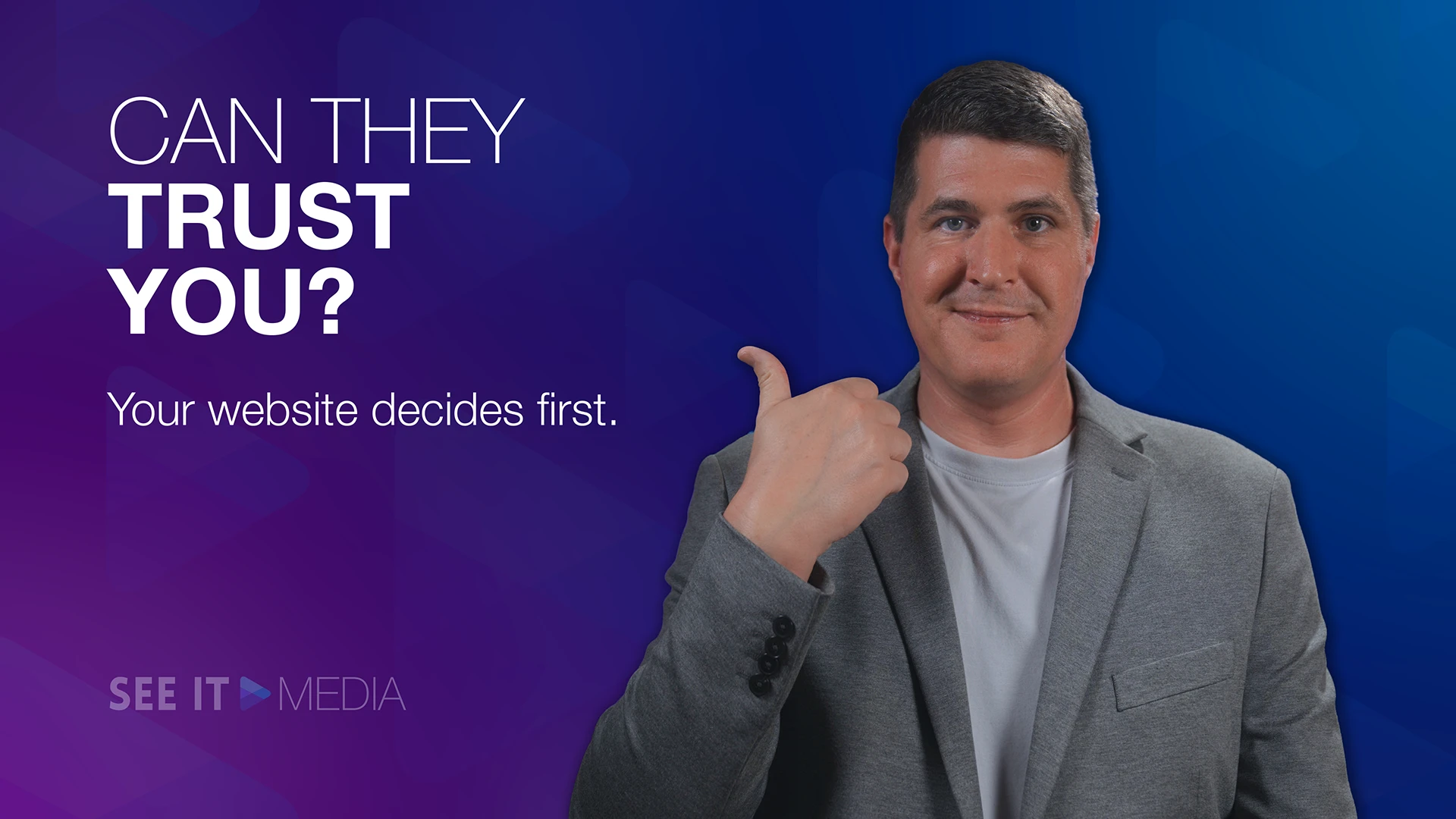

The Trust Gap: Why Website Trust Signals Matter Most
By See It Media | June 3, 2026
For the second installment of our video series, See It Media’s Director of Marketing, Thomas Schabow, is stepping in front of the camera. While our last video covered why video is the ultimate tool to capture attention, Thomas is here to talk about what happens after you get that attention.
When a prospect clicks your link, your website answers one fundamental question the absolute second they land on the page: Can I trust you?
The 50-Millisecond Decision
It takes about 50 milliseconds (that’s 0.05 seconds) for a user to form an opinion about your website that determines whether they’ll stay or leave. Most of that decision happens before a single word of your carefully crafted copy is ever read.
People do not evaluate websites logically at first. They evaluate them emotionally. The layout, the typography, the imagery – these aren’t just subjective design preferences. They are vital trust signals.
If your visual identity looks outdated or chaotic, visitors subconsciously assume your business operations are, too. Even if your actual work is exceptional, an unpolished website communicates inexperience. And once that negative perception forms, it acts as a filter for everything else: your proposals, your pricing, and your overall credibility.
What Do Your Website Trust Signals Say?
When we talk about visual liabilities, we aren’t talking about abstract art concepts. We are talking about basic principles that directly impact user psychology. Consider these real-world examples:
-
A cluttered layout: When a page is visually overwhelming and lacks clear navigation, it frustrates the user and communicates disorganization.
-
A mismatched color palette: Colors evoke emotion. When a palette is jarring or inconsistent, the brand feels disjointed and unstable.
-
An unprofessional font: Typography dictates tone. Using an unrefined or illegible font instantly strips away your authority and makes the business look amateur.
The “Trust Gap” Trap
Here is the massive gap that so many businesses completely miss: They invest heavily in getting attention. They pour thousands of dollars into high-end video production, SEO campaigns, paid social media ads, and networking to drive traffic.
But then, they send all of that hard-earned traffic to a website that quietly undermines the credibility they just spent money building. The marketing earned the lead, but the website lost it. That disconnect is the Trust Gap, and it breaks trust before the conversation even has a chance to start.
Design is Reassurance
At See It Media, we believe that design quality isn’t about vanity or chasing the latest aesthetic trends. It is about reassurance.
The ultimate goal of your website isn’t just to house information. Its job is to make the next step – whether that’s filling out a contact form, making a purchase, or booking a call – feel undeniably safe for someone who doesn’t know you yet.
How We Help You Close the Gap
Our digital marketing philosophy is simple: art and science, story and strategy – they are simply better together. When we take on a custom web design project, we aren’t just building a digital brochure. We are building a high-performing ecosystem designed to earn trust and convert your hard-earned traffic into revenue.
We view ourselves as a direct extension of your team, which is why our process is designed to completely remove the guesswork from your digital strategy. When you partner with us to close your trust gap, here is exactly how we start:
-
Step 1: The Deep Dive: We listen first. Before we ever open a code editor, we take the time to deeply understand your business, your audience, and your goals. We build a bulletproof strategy so every design choice serves a distinct, measurable purpose.
-
Step 2: Intentional Execution: We obsess over the craft. We build custom, high-end websites with the sole intention of making your brand’s credibility impossible to ignore. We don’t rely on generic trends; we build tailored solutions that signal authority.
-
Step 3: Performance Partnership: We stand beside you long after launch. A website is a living tool, and our goal is to ensure your investment drives real growth through analytics, SEO, and continuous optimization.
If your brand is doing high-level work, your website should actively reflect it. If you’re ready to align your digital presence with the actual quality of your business, reach out to See It Media and let’s start the conversation.
Frequently Asked Questions About Website Trust Signals and Design
Q: How do you know if your website makes a good first impression?
Start with your homepage. Does the top of the page, above the fold, immediately communicate what your business does and who it serves? A clear H1 heading, professional imagery, and a clean uncluttered layout are the baseline. If a stranger cannot identify your business category within five seconds, the first impression is already working against you.
Q: After making that first impression, what else do I need to focus on?
Navigation and flow. Your menu should be simple, logical, and consistent across every page. Visitors should never have to guess where to go next. The website should tell your story in a sequence that builds confidence, from who you are, to what you do, to why it matters, to what to do next. Consistency in fonts, colors, and tone across every page reinforces that your business is organized and trustworthy.
Q: What role does typography play in website credibility?
Typography communicates tone before content does. A professional, readable font signals authority. An inconsistent or decorative font signals inexperience. Stick to one or two complementary fonts, use sizing hierarchy to guide the eye, and ensure body text is legible on both desktop and mobile.
Q: How does image quality affect whether someone trusts my business?
Low resolution images, stock photos that feel generic, and visuals that do not reflect your actual work all create doubt. Original photography and professionally produced video consistently outperform stock imagery for building credibility because they show the real business behind the website.
Q: What is a call to action and why does it matter for conversions?
A call to action tells the visitor what to do next. Without one, even interested visitors leave without taking a step. Every key page on your website should have one clear, specific action: book a call, request a quote, watch a video, or contact us. Competing calls to action on the same page create confusion and reduce conversions.
Q: How does website design affect search engine rankings?
Search engines track behavioral signals alongside keywords. How long someone stays on your page, whether they engage with content, and whether they bounce immediately all feed back into how your site ranks. A website that builds trust keeps visitors on the page longer, which sends positive signals to search engines and supports your overall SEO performance.
Q: What is the connection between video and website credibility?
Video placed strategically on key pages, particularly the homepage and core service pages, increases time on page significantly. A visitor who watches a 90-second video stays engaged far longer than one reading the same information as text. That engagement signals to search engines that your content is valuable, and it gives prospects a faster path to trusting your brand.
Q: How do I prioritize website improvements if I have a limited budget?
Focus in this order. First, ensure your homepage communicates clearly what you do and who you serve. Second, audit your navigation for simplicity and logic. Third, replace low quality imagery with professional visuals. Fourth, add or sharpen your calls to action on every key page. These four areas deliver the highest return on credibility per dollar spent before moving into deeper design or development work.
At See It Media, we work with companies of all sizes and budgets. If you are working with limited resources but know your website needs attention, there may still be ways we can help. Sometimes a few targeted fixes make a significant difference. Reach out and let us take a look at what is possible for your situation.
Recent Posts

Social Media Video: The False Reality of the Influencer Reel
Social Media Video: The False Reality of the Influencer Reel
Motion Graphics: Make the Complex Simple
Motion Graphics: Make the Complex Simple
Custom Website Design: Great Sites Are Never Accidents
Custom Website Design: Great Sites Are Never Accidents
